
The Clock That Was Never Late
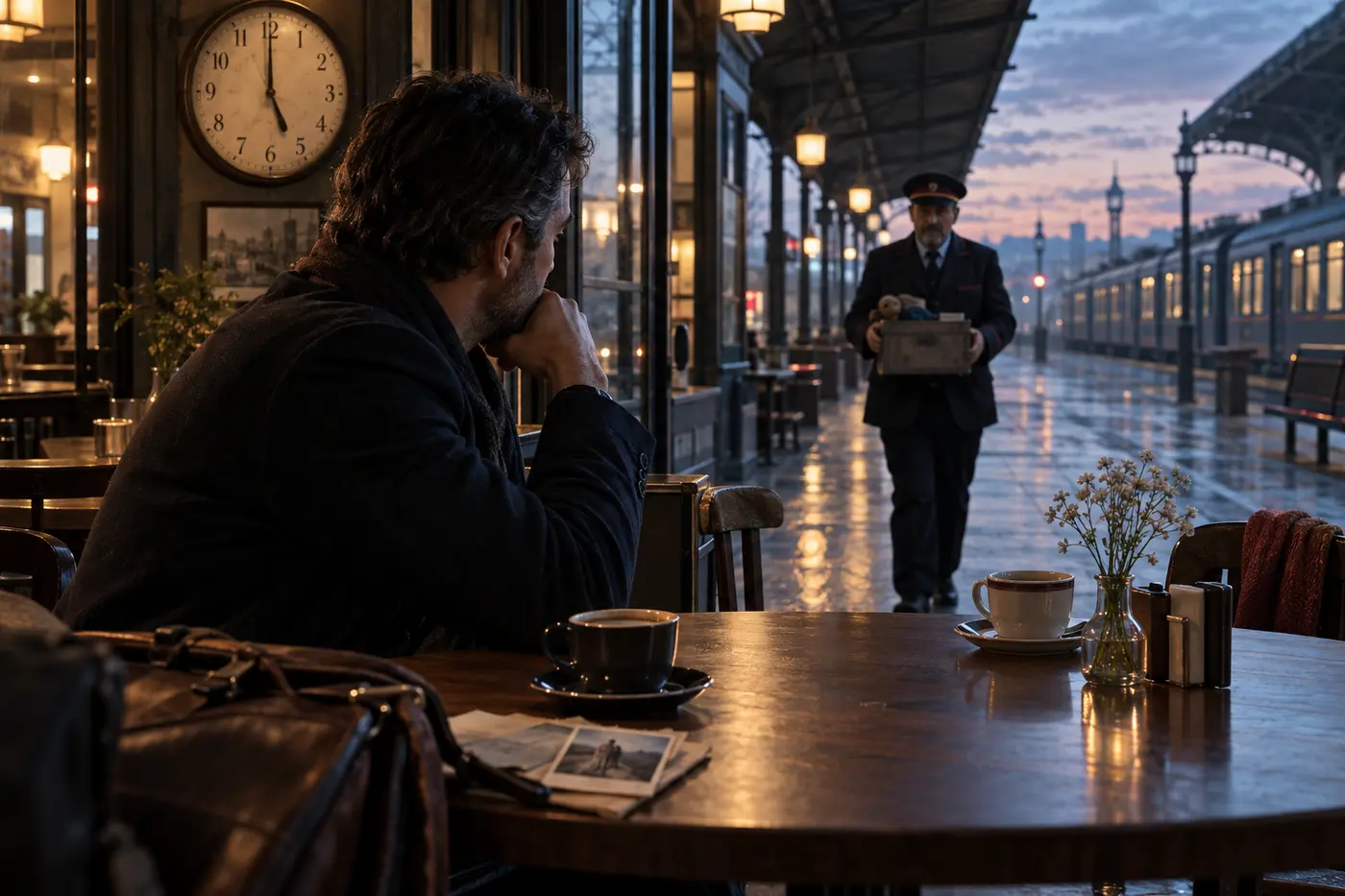
At 5:40 a.m. on November 18, Nadim ordered two coffees and sat at the same table for the twelfth year in a row.
He put the second cup before the empty chair and adjusted its spoon until it lay parallel to the saucer’s edge. The waiter no longer asked whether he was expecting someone. Only new employees glanced at him before learning the rule from the older staff: do not clear the second cup before 6:15 a.m.
The train he had originally waited for had long been cancelled, then renumbered, then removed from the timetable altogether. But the café clock remained on the wall, one minute fast as it had always been.
Twelve years ago, Rana told him: “If you decide to come, I will be at the cafe before six.”
He told her he would come.
He arrived at 6:20, and did not find her.
From that day on, he built his life around 20 minutes. He said she was late, then he said she changed her mind, then he said she chose another city. He didn't call her because, in his story, his dignity was the only thing that arrived on time.
In the first year, he asked about train movements, although he knew Rana would not arrive on another train. In the third, he began leaving his phone on the table as though expecting a call. In the seventh, he switched it off and told the waiter that some mornings should remain as they began. He liked how faithful that sounded, without asking himself whom he was being faithful to.
The last thing he did before leaving home was choose his darkest coat. His old coat had worn out long ago, but he still disliked pale colours on that date. Once, seeing a young man help a woman carry a large suitcase, he left the café before 6:15 a.m. He told himself the noise had spoiled the place. Later, he forgot the noise; he remembered the young man’s hand on the suitcase handle.
This year, a new waiter stood by his table and asked, "Should I leave the milk with the two cups?" Nadim almost answered as usual, then realized he didn't know how Rana drank her coffee now. He knew how much sugar she liked when she was twenty-four. But the woman she had become, he knew nothing about. He moved the milk aside and said, "Leave it here."
He looked at the windowpane. His face was reflected on the empty pavement, and he did not see the young man who awaited him in his memory. He saw a man who grew older every year, while asking one morning to stay where it was.
The Gray Box
At 5:55 a.m., a man in the railway station’s old uniform approached, carrying a small metal box.
He said: "Are you Nadim Shawqi?"
Nadim's hand froze around the cup.
The man sat down uninvited and placed the box between them. He introduced himself: Sameh, the last employee from the station's team before its renovation. They were emptying the lower storage room and found items that hadn't entered the digital system.
He opened the box. Inside were a rust-colored scarf, a small camera, a canvas wallet, and a broken wristwatch.
Nadim recognized the scarf before he even touched it.
He said, "These are Rana's things."
Sameh took out a faded piece of paper card tied with string. It said: “Found on platform 3, 5:52.”
Nadim said, "So she was here."
He didn't feel joy. He felt as though 12 years of anger had suddenly lost their balance.
He asked, "What happened to her?"
Sameh said he did not know. That morning, an electrical fault had led to part of the platform being evacuated after water leaked through the roof. Abandoned bags were hurried into storage. These belongings remained unidentified because the wallet held no identity card.
But the camera contained a memory card.
Images that start from the end
Sameh brought an old computer from the station office. The photos appeared in chronological order. Rana was standing in front of the station entrance, the sky still dark. Rana was holding two cups. Rana took a picture of the café clock at 5:31.
Nadim said, "She was waiting for me."
The next photograph had been taken inside the café. It showed the seat Nadim occupied now, with two cups on the table. Then came a photograph of the platform, followed by a blurred image of a man running near the gate, his face out of view.
Nadim enlarged the picture. The coat looked like his old coat.
He said, "That's not me. I arrived after six."
Sameh did not respond. He moved on to an 18-second video file.
The cafe door appeared. A young man rushed in, stopped in front of Rana, and then sat down. His face was not visible to the camera, but his voice was clear.
Nadim's voice.
In the recording, he said, ‘I can’t travel with you. I only came to tell you that.’
The video cut out.
Nadim raised his eyes. The cafe around him was silent despite the sound of the coffee machine.
Nadim said, ‘That’s been edited. I wasn’t there.’
Sameh pushed the broken wristwatch towards him. On its back was a small inscription: ‘For Nadim, so fear will not speak for him.’
Nadim reached towards the computer to replay the clip, then left his hand suspended above the table. He wanted one more sentence, anything that might make his refusal less final. But the recording ended at the same point. When he asked Sameh to play it a third time, the man lowered the volume. ‘You can take a copy. You don’t have to watch it all now.’
Sameh’s kindness unsettled Nadim. An accusation would have given him something to defend against. A suggestion that the camera was wrong would have given him a word to cling to. Instead, that space made him feel the chair’s weight beneath him. At the edge of the screen, Rana’s hand moved to her scarf. He recognised the gesture before understanding it: she would pull its end between two fingers when trying not to interrupt.
He said, "She would have asked me if I was afraid."
Sameh asked, ‘And did she ask you?’
Nadim did not answer. Rana’s voice returned from a memory older than the video: ‘We don’t have to decide our whole lives today. Come and see the place for a week.’ He had erased that offer from his account too. He had made the move seem an irreversible leap so his refusal would look reasonably cautious, and her departure a verdict against him so he would not have to see that he had left her to choose alone.
The memory that served its owner
Nadim remembered the coat and the rain. He remembered standing outside the station before 5:30 that morning and seeing Rana through the glass. He remembered his father’s call the previous night, warning him against leaving his job to follow an uncertain project.
Then he remembered the sentence he had said to Rana.
He wasn't late.
He had arrived early, said he would not travel and left before the confusion on the platform began. He returned after 6:20 a.m. because he regretted it, but Rana was gone. When a friend asked later, he said he had arrived late. He repeated that sentence until it swallowed everything that came before it.
Nadim asked Sameh, ‘How could I have told it that way all these years?’
Sameh answered, ‘I don’t know. I wasn’t there with you. But now you’ve heard what you said to her.’
Inside the wallet, they found a folded note that hadn't been sent. It was in Rana's handwriting:
“Nadim, if you come back you won’t find me here. Not because you were late, but because you came to say goodbye to the decision before giving it a chance. I will go alone. And if you ever change your mind, don’t wait for me at the station. Look for me where I went.”
At the bottom of the paper is the name of a coastal city and the address of a photography workshop.
The Second Cup
The address was old, but searching for it led Nadim to a photography gallery page bearing Rana’s name. Its latest update was two weeks old. The cover photograph showed a woman beside the sea. Older, of course—but unmistakably Rana.
He opened his phone's contacts, searching for his old friend. He reached the call button, then stopped. For years, that friend had heard the same story: a train station, a delay, a woman who left without saying goodbye. Nadim wanted to tell him he'd discovered something strange, to attribute the mistake to the camera or to his own memory. He closed the contacts. If he started softening the truth in front of an old witness, he'd end up with a new version of the lie.
He took a piece of paper from his pocket and wrote two lines. The first read, “I was afraid of failing.” The second, “I told her I wouldn’t come.” He kept looking at the difference between them. The first explained what he felt; the second described what he did. He didn’t have to choose one and discard the other. He folded the paper and placed it under the broken clock, then picked up the phone.
Nadim wrote a long message, then deleted it. He wrote an apology explaining his family's pressure and his fear, then deleted that too. Finally, he sent:
‘I was at the station. I said I hadn’t arrived, and believed it for years. I found your letter today. I’m sorry I made you carry my decision, then blamed you for my absence too. I’m not asking for anything. I wanted you to know that I remembered the truth.’
He kept looking at the screen. There was no response.
At 6:15 the waiter came to take the second cup as usual.
Nadim stopped the waiter and pushed the cup towards Sameh.
He said, "Drink it. It shouldn't get cold again for someone who isn't here."
An hour later, as he was leaving the station for the first time before noon, his phone vibrated.
A message from Rana: ‘I wondered when you would finally reach that morning. I can’t bring back the past, but we can talk. Somewhere other than a train station.’
Nadim looked up at the large clock. It showed 7:22, a minute ahead as usual.
He smiled. For 12 years he blamed the clock, the train, and Rana for being late. Only the clock was never late. It always showed the time he chose not to see.
The conversation that wasn't a date
They arranged a call three days later. Rana did not ask why he had failed to follow her, but why he had returned to the station every year instead of looking for her address.
Nadim said, ‘Because waiting made me the one who had been wronged. Searching would have forced me to risk finding you—and hearing what I had done.’
She said her life didn't end that morning. She traveled, her first workshop failed, and she started again. The woman sitting in his memory hadn't been waiting for his explanation for 12 years.
He felt ashamed, but this time did not turn shame into a defence. He told her about the box. She laughed at the mention of the watch, saying she had bought it at a cheap market and that the engraving had cost more than the watch itself.
He sent her the scarf, the camera, and the original letter. He kept the watch with her permission because she said the time he had repaired didn't need a working device.
They did not agree to revive their old relationship. They agreed to one meeting a month later, at noon, in her gallery during opening hours, in the coastal city. There would be no train waiting for anyone and no chair reserved for an imagined story.
On the day of the exhibition, Nadim arrived a quarter of an hour before noon. He waited by the door until Rana opened it herself, then said he could return on time if she wasn't ready. She laughed and said that a quarter of an hour was enough to help her lift the box of brochures. He carried it to the table, making no attempt to make the small gesture a sign of a new beginning.
He paused in front of a photograph of a wooden chair on a balcony overlooking the sea. He asked her when she took it. She said, "After the first workshop closed. The landlord wanted the chair, and I wanted the photograph before he took it." The photograph wasn't about waiting for a man, nor about a station. It was about a life he hadn't been in, and about a loss she had learned to cope with without him.
When visitors arrived, Nadim stepped away from the desk and let Rana welcome them. He heard her explain a photograph, disagree with a visitor about light, then call an assistant whose name he had never heard. For the first time, he saw Rana not at the end of his story but in the middle of her own. When she beckoned him over, he approached without counting the minutes.





التعليقات (0)
لا توجد تعليقات بعد. كن أول من يشارك برأيه.
لإضافة تعليق، يرجى تسجيل الدخول أو إنشاء حساب. يمكنك قراءة التعليقات دون تسجيل الدخول.