
The City That Borrowed Its Shadows
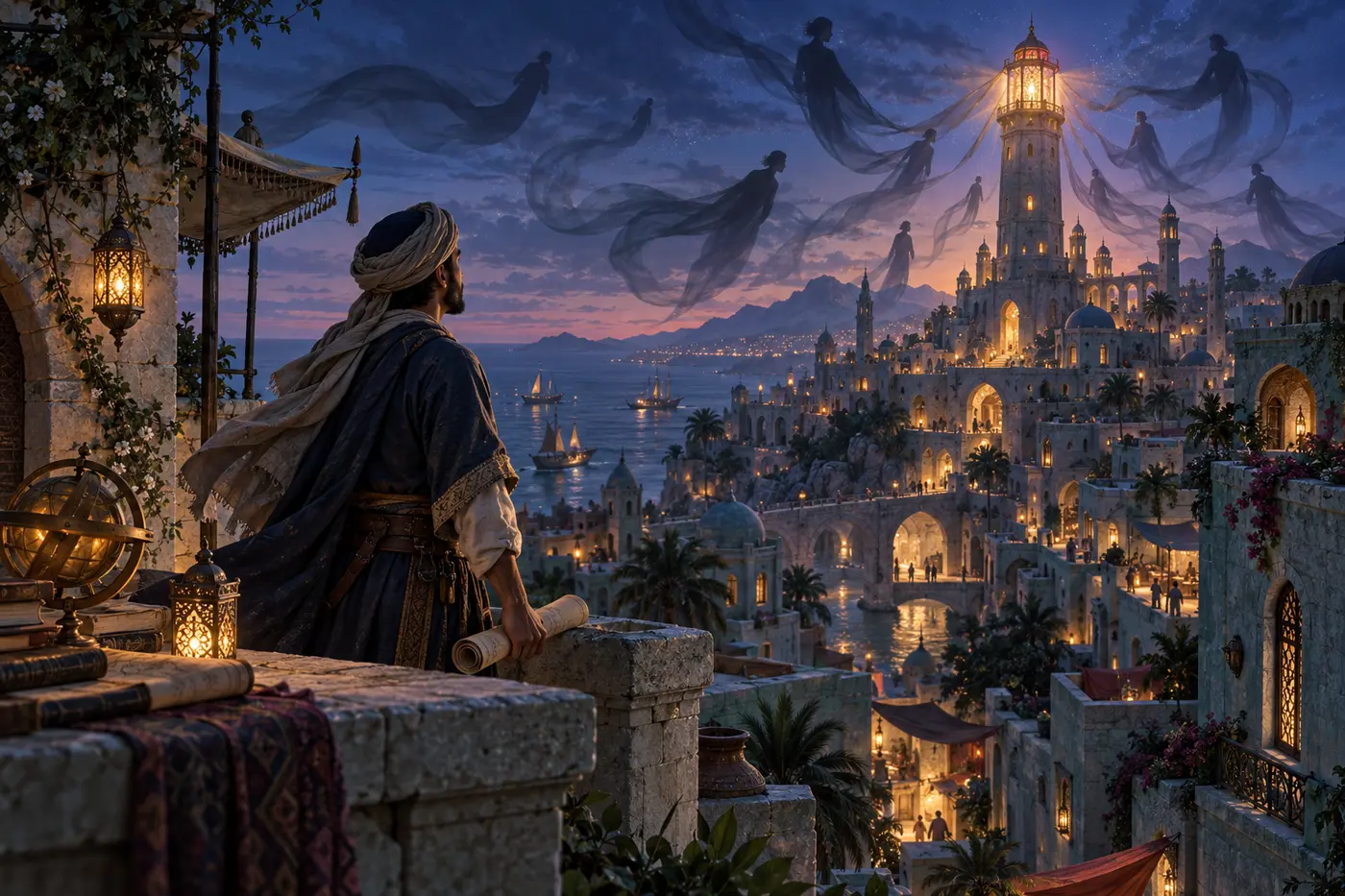
In the city of Sura, one could lend their shadow to the lighthouse for 30 days in exchange for a single wish. This was considered one of the city's oldest laws, until a cartographer discovered that some shadows were never returned, and that the most dangerous thing was not losing a shadow, but forgetting that you had lost it.
Sura was built on three stone terraces descending towards the sea. The white lighthouse stood at the top, markets and flat-roofed houses filled the middle, and the harbour lay below, its masts a black forest at dawn. Nobody knew when the lighthouse had begun accepting shadows. According to the story, its first keeper found a woman waiting at the door during a drought, asking for rain. She had nothing to offer, but her shadow fell across the threshold like a black cloth. The light took it, and rain fell that same night.
Since then, bartering has become a system. The lighthouse does not give gold, nor does it bring back the dead, nor does it make anyone love someone they don't love. But it may bring rain to a field, or guide a sailor home, or give a sick person a pain-free night, or keep a well from drying up until water reaches it.
At sunset, a person seeking a wish would enter, stand before the old lens and speak their wish aloud. Their shadow would separate from their feet, climb the tower steps and remain there for thirty days. At sunrise on the thirty-first day, the shadow would return to its owner.
That was the law.
The Man Who Mapped What Others Could Not See
Nadim was the city's cartographer. He wasn't a magician, and he didn't like people describing his work as such. He used to say that a good map doesn't predict the route; it prevents you from lying to yourself about where you are.
He inherited the profession from his father, and with it, a cramped room in the records office, with high windows and the lingering smell of ink. He would draw new alleyways, correct the boundaries of orchards, and record the names of those who lent their shadows to the lighthouse. Each name was marked by a small black line running across the margin of a large register, which would then disappear the day the shadow returned.
Nadim did not believe in free wishes. He saw people climb to the lighthouse carrying a problem, and come down lighter, but he knew that everything in Sura had a price, even things whose prices were not written.
His younger brother Yamen once said to him: "You even doubt the rain."
Nadim replied: "No. I only doubt those who say it's free."
Yamen was a sailor who couldn't stay on land for more than a few weeks. He saw the sea as a path, while Nadim saw it as an empty space that couldn't be fixed on paper. That's why their arguments were frequent: one wanted to know where he stood, and the other wanted to know where he could go.
Two weeks before the story begins, Yamen left with a merchant ship heading north.
Six days later, the other ships returned after the storm.
His ship did not arrive.
The Baker’s Shadow
On the morning of the thirty-first day after Salma the baker made her wish, Nadim opened the register, expecting the black line beside her name to have disappeared. It was still there, darker than before.
He went to her bakery.
Salma was taking the loaves out of the oven, and the light behind her cast shadows of the baskets and shelves on the wall. She alone had no shadow.
Nadim said, ‘Your shadow is due back today.’
She raised her head in surprise. "Return to what?"
He thought she was joking.
He pointed to the ground.
Salma looked down at her feet, then at the wall. She frowned for a moment, then said, "Strange. Maybe I didn't have a clear shadow to begin with. The bakery is dark."
The bakery was lit by the morning sun.
He asked her about her wish.
She asked, ‘What wish?’
He opened the pocket notebook he was carrying. She had asked that the rain continue for three nights in the eastern wheat fields after the irrigation canal had dried up. Nadim himself remembered that she had come to the lighthouse carrying an empty flour sack.
But Salma shook her head. "It rained, yes. What does that have to do with me?"
At that moment, Nadim smelled the aroma of bread sweetened with anise.
He said, "This is your mother's recipe, isn't it?"
Her hand stopped over the tray.
"I don't know."
He knew that Salma talked about her mother every time she sold him a loaf of bread.
He returned to the records office feeling for the first time that the black line was not an administrative sign, but a warning.
The Second and Third Missing Shadows
The next day, the blacksmith Raef's shadow was late. He had hoped that his wife's fever would subside for just one night so she could sleep. His wish came true. She later recovered with treatment, but his shadow did not return on time.
Nadim asked him about the song he used to sing to his wife while she was sick.
Raef said, "I don't sing."
Nadim had heard him.
Two days later, a third name remained marked in the register. A woman from the harbour district had lent her shadow to the lighthouse so her young son could reach a doctor in the next town before floodwater closed the road. The boy survived, but she no longer remembered why the sound of water frightened her.
Nadim went to the lighthouse keeper, a man named Hashem who had spent 40 years among the lenses and ladders.
Hashem said: "Sometimes the wind delays the shadows."
Nadim said: "The wind does not erase memories."
The guard didn't look at him.
Nadim then realized that the man was afraid, not ignorant.
A map that erases itself
Nadim drew the locations of the three houses on Sura's map. He connected them with lines, then added the lighthouse. Nothing appeared. He remeasured from different angles, and used older maps, until he noticed that the lines did not point to the lighthouse itself, but to a place below it, outside the boundaries of the current neighborhood.
He took out a 70-year-old map.
There was a small neighborhood between the market and the slope, called the Old Wall neighborhood. It disappeared from the maps after an earthquake destroyed half of it, and then new buildings swallowed up what remained of it.
Even stranger, the name on the old map was unusually faded, as if someone had tried to erase it after drawing it.
Nadim went out at night.
He found the entrance to an alley behind a spice shop. It was so narrow that his shoulders almost touched the walls. At its end, steps descended below street level.
There he saw, for the first time, a shadow moving without an owner.
It passed over the wall like a flat cloud of smoke, then another followed, and a third.
The shadows were not entirely silent. As he drew closer, he heard the laughter of a woman with the first, a short melody with the second, and the sound of a wave crashing against a stone barrier with the third.
He understood suddenly.
Every shadow carries something other than darkness.
Maysaa, Keeper of Wishes
The shadows led him to an iron door at the bottom of the lighthouse. Behind it was a tower older than the one the townspeople could see, buried deep within the rock. In its center was a huge glass vessel, taller than two men, with a dark, water-like light swirling inside.
A woman stood before him carrying copper strips and delicate instruments. Nadim recognized her: Maysaa, the keeper of wishes. He had seen her at the lighthouse but didn't know her work extended to this place.
She said without turning around, "You shouldn't have come here."
He said, "The shadows should have returned."
She turned around. She looked more tired than guilty.
She showed him a thin crack in the glass. Whenever a shadow passed near it, a small light separated from it and remained inside the vessel.
She said: “The lighthouse does not create wishes out of nothing. The shadow carries a memory associated with what its owner wishes for. The lighthouse uses its effect to direct the light. When the wish is over, it brings back the memory with the shadow.”
Nadim said: "So Salma gave her mother's memory so that it would rain?"
‘She didn’t knowingly give it up. That is part of the old system.’
Nadim felt angry. "They call it barter and they don't tell people what they're paying."
Maysaa said, "Because the memory always came back."
She pointed to the crack.
‘Until now,’ she said.
What If the Vessel Broke?
Maysaa explained that the crack started months ago. At first, the vessel held small fragments: the color of a door, a street name, half a melody. Then it widened and began to hold the whole memory. She tried to mend it, but every new wish only increased the pressure.
Nadim said, ‘Stop granting wishes.’
She said: “There are wishes being granted. A water channel is relying on rain this week. Three ships are following a light enhanced by the lighthouse. A patient is experiencing peaceful hours thanks to his daughter’s wish. If I turn off the system now, we might harm those we are trying to save.”
‘What if we break the vessel?’
‘The memories would return at once, but every wish linked to it would stop working.’
Nadim looked at the shadows wrapped around the glass.
‘And if we leave it as it is?’
Maysaa said, “The city will continue to get what it asks for, but it will gradually forget why it asked for it. There may come a day when people live in safety and do not remember those they loved enough to ask for safety for them.”
The wish that Nadim hid
Maysaa did not know that Nadim himself had become part of the problem.
A week earlier, once he was certain Yamen’s ship was missing, Nadim had climbed to the lighthouse after midnight. He had told nobody. Standing before the lens, he had said, ‘I want my brother to return alive.’
His shadow separated.
Since then, Nadim had avoided the sun so nobody would notice that his shadow was missing.
He didn't tell himself what else he paid. He kept saying that fear for Yamen justified any price, and that 30 days without a shadow meant nothing if his brother returned.
Now Nadim asked Maysaa, ‘What memory does my wish carry?’
Maysaa searched the light until she found a thread bearing his mark.
She touched the thread.
Nadim heard the sound of two children running along the pavement. He saw himself as twelve and Yamen as seven. His brother had fallen into the water, and Nadim jumped in after him even though he wasn't a good swimmer. A fisherman pulled them out, and then Yamen said, trembling, "I knew you'd come."
Nadim retreated.
That memory was the basis of all his fear: that a day would come when his brother would need him and he would not reach him.
Founder's Map
He spent the night in the archives searching through maps of the first lighthouse. Before dawn, he found a folded piece of paper inside a worn atlas cover. It wasn't a street map, but a geometric section of the buried tower.
The founder drew 7 narrow windows extending from the east to the vessel chamber. In the present building, they were all enclosed with stone.
Beside the drawing, the founder had written: ‘If the light becomes the vessel’s property, give it back the dawn.’
Nadim understood that the vessel had never been meant to remain in darkness. Each morning, sunlight had passed through it and restored what it held. Over generations, the keepers had enlarged the lighthouse and sealed the openings to make storerooms and staircases. Then they had forgotten what the openings were for.
The problem was not that the magic had been corrupted.
The city repaired the lighthouse until it ruined it.
The Price of Opening the Windows
Nadim told Maysaa what he had found. She said the windows could be opened from inside, but their locks were bound to the borrowed shadows. She needed a shadow whose owner willingly withdrew a wish: the system could not release its memories while everything inside remained bound to grant one.
Nadim knew what that meant.
If he regains his shadow now, his wish for Yamen's return will cease.
Maysaa said, "We can wait. Perhaps your brother will return first."
He looked at the names Salma, Raef, and the third woman in his record. There were new names as well.
"And how many people will have forgotten by then?"
She did not answer.
Nadim stood before the vessel. ‘I withdraw my wish,’ he said. ‘Give me back my shadow.’
Nothing happened for a moment.
Then a black line separated from the swirl inside. His shadow emerged from the glass and passed beneath his feet without settling there. It climbed the wall like a climber without a body and reached the first stone lock.
Maysaa opened it.
A thin thread of dawn entered.
The shadow opened the second, third, and fourth windows. With each window, the light spread across the room.
The vessel shook.
It didn't break.
Glowing threads shivered inside the vessel, still turning behind the glass.
But the fifth window wouldn't open. Nadim's shadow rested on its lock, and the light remained at the edge. Maysaa lifted the lamp and saw a crack filled with stones newer than the wall. It wasn't in the founder's plan. During the years of maintenance, someone had blocked the space to stop the whistling wind, and those who came after him forgot that there was a window beneath the stones.
From above came the guard's voice calling. Dawn was approaching, and the vessel in the center of the room trembled like a chest struggling to breathe. Maysaa picked up an old tool from near the stairs and began to loosen the first stone. Nadim placed his hand underneath to catch what fell. A small piece cut his finger, and he noticed the coldness of his hand and that his body was still there, however untouchable the light might seem.
Maysaa asked him: "Do you want to stop?"
He thought of Yamen, not just his image, but the possibility that he would never find him. The wish gave him a certainty he could sleep with. He lifted the stone to the ground and said, "I want the fear to stop. That's something else."
The guard came and helped them remove what remained. The crack opened to the scent of bread and sea. Nadim's shadow slipped into the last two locks, and the full light of dawn entered. No one called out that the city had been saved. The three stood listening to the sounds coming from outside, waiting to learn what had returned, and what the city would have to carry itself. Finally, the threads emerged from the vessel, like swarms of light, and passed through the open windows toward the houses.
When the City Remembered
In the bakery, Salma stopped with her hand inside the dough. She suddenly remembered her mother's kitchen, the green scarf she used to wear, and the way she would add the anise without measuring. She sat on the floor and cried while laughing.
In the blacksmith's workshop, Raef stopped hammering iron. A melody he thought he had never known returned to him. He went out into the street singing it.
In the port district, the woman remembered the sound of the flood and the small hand she had been holding as she ran towards the cart.
And across the city, people returned to memories they didn't know were gone: the cause of a wish, a face, a promise, a fear, the smell of home.
Nadim's shadow returned to his feet.
And with him came the memory of Yamen.
But his wish was no longer working.
The Search That Replaced the Miracle
Nadim left the lighthouse at sunrise. He didn't know if his brother was alive.
For the first time since the ship disappeared, there was no magic working in secret for him.
He went to the port.
The sailors gathered maps and wind reports. Some had only just recovered memories of earlier escapes at sea—memories the lighthouse had taken. An elderly captain remembered a cross-current that formed after northerly storms and swept wreckage towards a chain of rocky islands outside the merchant shipping routes.
Nadim drew the path.
He said, "If his ship lost its rudder here, the current may have taken it to these islands."
The owner of one of the boats said, "We will search."
Within an hour, 5 boats left.
Nadim wasn't the only one asking them for this. Yamen had repaired one person's window for free, saved another's cargo in a storm, and carried messages from many families on his travels. What began as a personal wish had grown into a sentiment shared by dozens of people who remembered why they wanted him back.
Two days later, a boat appeared on the horizon, raising a red cloth.
Yamen was on board, injured in his shoulder and tired, but alive.
When he reached the quay, Yamen said to Nadim, ‘I knew you would come.’
Nadim laughed for the first time in weeks.
He said, "This time half the city came."
Is the lighthouse closing?
The people of Sura did not agree on what should be done.
Some demanded the immediate closure of the barter system. Others argued that the lighthouse had saved fields, ships, and lives that human intervention could not have saved as quickly.
The wheat merchant stood in the council square and said: “When the field dries up, it is no use explaining the philosophy of memories to the farmer.”
Salma answered from the crowd, ‘And I forgot my mother’s face in exchange for three nights of rain. If nobody told me the price, could you call my choice free?’
Silence prevailed.
Maysaa said the problem was not that the lighthouse possessed magical power. It was that the system made people pay a price without knowing what they were giving up.
Nadim said: “If the city needs a miracle every week to function, the problem is not a lack of miracles.”
The Three Shadow Laws
Before closing the barter system, Maysaa asked Nadim to write down what they had learned. He first wrote three rules: a shadow must carry only one wish; nobody should make a wish on behalf of someone they do not know; and every memory taken must be returned intact.
He read it a second time.
Then the third law was crossed out.
Maysaa asked, "Why?"
He said: "Because the problem is not in guaranteeing the return of the item. The problem is that we accepted taking it without the owner knowing."
The council agreed to try a full year without bartering shadows.
The lighthouse continued to function only as a lighthouse.
A year without wishes
The year was harder than people liked to admit. Nadim drew up a network of canals to collect winter rainwater. The farmers dug them in stages. The sailors identified sheltered coves and marked new rocks. Raef opened his workshop two days a month to repair the farmers' tools at cost.
Their new ways did not work as quickly as the old miracles.
A small crop failed in the south. A ship was delayed a week. Trees that the lighthouse could have brought rain to in a single night died.
Critics of the decision always mentioned these things.
But other things happened too. The people of the neighborhood built communal water tanks. The sailors set up a signaling system between the lighthouse and the boats. Families learned the names of those they could ask for help instead of waiting until sunset and going alone to the tower.
Most importantly, Nadim's record remained free of names that do not remember why they were written.
The neighborhood that's back on the map
At the end of the year, Nadim redrew Sura. He did not limit himself to the new streets. He restored the Old Wall district to the map, including alleyways that survived only as stones beneath later buildings.
He marked the buried tower too.
One of the council members objected: "Why are we drawing an enclosed space?"
Nadim said: “Because deleting the place does not delete what happened in it. It only makes it easier to repeat it.”
The new map was placed on display in the House of Records, and anyone could see it.
As for the glass vessel, they left it in its place, empty, and the seven windows were open to the dawn.
The Day the Shadows Return
A year later, the people of Sura gathered at sunset. Nadim expected the council to suggest a large festival, but Salma suggested something simpler: that each person sit with another and tell them a memory they were afraid of losing.
Seats were spread out on the steps leading down to the sea.
Raef told of the first time he heard his wife sing. Salma described her mother leaving a fingerprint in every loaf before putting it in the oven. Yamen recalled the day his brother jumped into the water after him, despite not being a strong swimmer.
Nadim said, "You could have chosen a less embarrassing story."
Yamen said, "But this is the best one."
At sunset, the shadows of the people on the stones stretched long and overlapping. They did not belong to the lighthouse, they were not debts, and they did not hold secret wishes.
They were just shadows.
Has the lighthouse remained magical?
After the celebration, Nadim found a child standing in front of a map of the city.
The child asked him: "Is it true that the lighthouse granted wishes?"
Nadim said: "That's right."
‘And can it still do that?’
Nadim looked out of the window. The lighthouse light was swirling above the sea. Below stretched the canals that people had dug. On the dock, sailors were checking weather signs before a night voyage.
Nadim said, ‘It can guide ships on their way.’
The child frowned. "This isn't magic."
Nadim smiled.
"Perhaps. But the city spent too long asking the lighthouse to do alone what we should have learned to do together."
That night, Nadim returned to the records office and completed the margin of the new map:
“A wish that doesn’t remember its price becomes a cage. But a hope that knows its price, seeks help, and works with others doesn’t need to borrow your shadow.”
Nadim turned off the light.
When he went out into the street, the moon was behind him, and his shadow was in front of him, following him home.





التعليقات (0)
لا توجد تعليقات بعد. كن أول من يشارك برأيه.
لإضافة تعليق، يرجى تسجيل الدخول أو إنشاء حساب. يمكنك قراءة التعليقات دون تسجيل الدخول.