
The Floor That Rose on Its Own
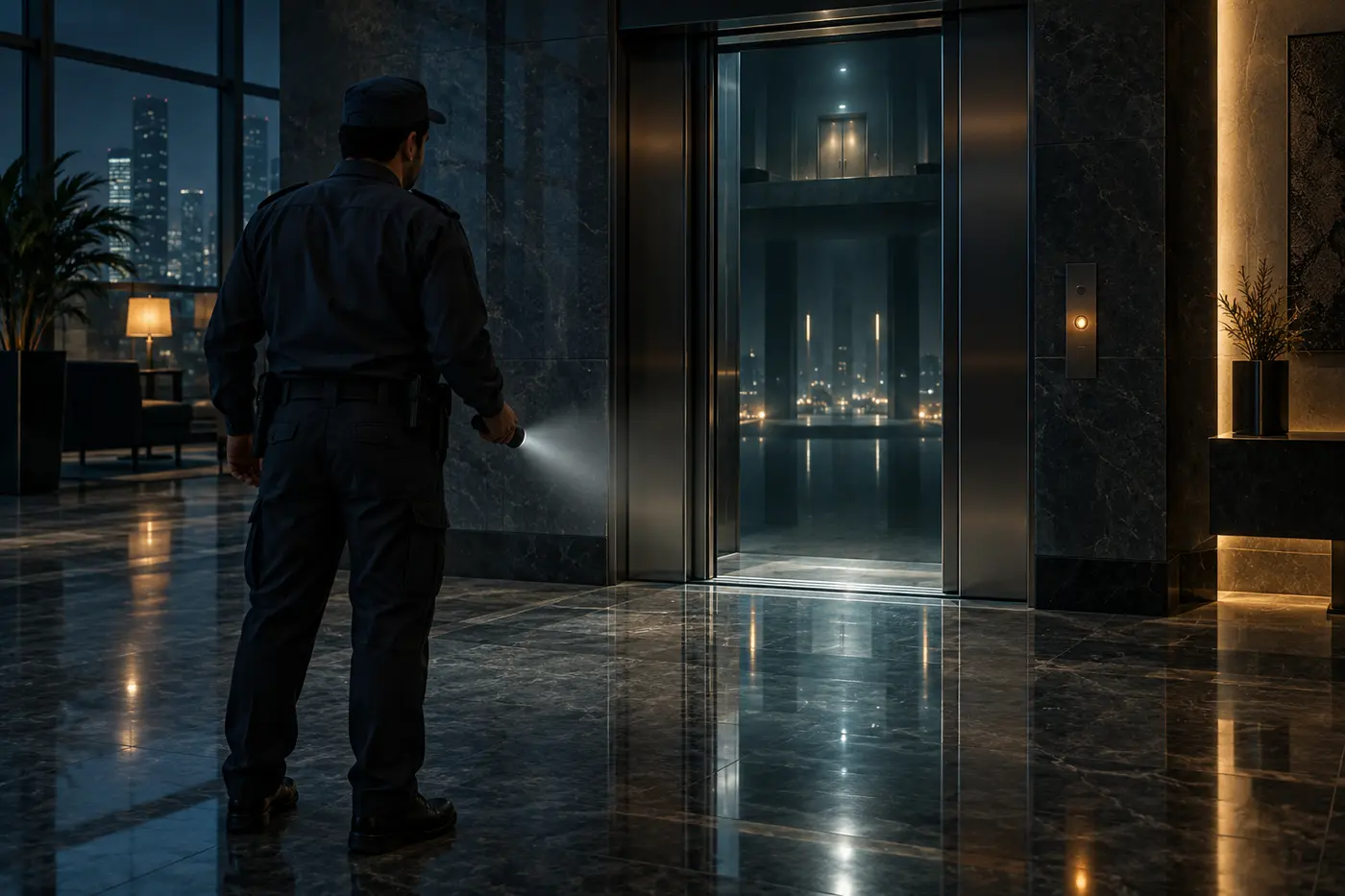
Every night at 2:13 a.m., elevator number 4 rose empty from the lobby and stopped at a floor that did not appear on its control panel.
Samer noticed it during his first week as a night guard at Al-Nada Tower. The security monitor recorded the journey as lobby, floor 18, a blank dash, then the return. The supervisor told him the system made mistakes after midnight and ordered him not to take the elevator out of service over a stray number.
But the error began leaving traces. On Tuesday morning, Samer found grey dust inside the elevator cabin. On Wednesday, he smelled burnt wood. On Thursday, a woman’s voice came calmly through the emergency speaker: ‘The door won’t open from our side.’
Samer answered the woman and asked where she was. There was no reply, but the button for floor 18 lit up by itself. He took his flashlight and went up.
Before that night, Samer loved the hours before dawn. The tower would quiet down, and he could hear the kettle stop in the guard room. He'd open the lunchbox his mother had prepared and read his daughter's homework note. In a building with hundreds of people, his shift gave him a small sense of control: locked doors, clear exits, and names recorded for entry and exit.
After the smell of burnt wood, he stopped warming his food. His lunchbox stayed open on the table until morning. Whenever the elevator approached the lobby, he looked at the gap between its doors before looking at the monitor. He was not afraid of seeing someone. He was afraid of knowing someone was there and being unable to see them.
On Wednesday night, he had placed a white sheet of paper on the cabin floor, clear of the door track, and waited beside the security monitor. He wanted to know whether the dust fell during the ascent or arrived with the morning workers. The paper came back with a curved grey line in its centre, like a heel mark left by someone turning. He replayed the footage. Nothing had changed: an empty cabin, a steady light and doors opening in the lobby.
He called his supervisor. In the background, he heard a television and a spoon clinking in a cup. ‘If you follow every old noise, you won’t last the week,’ the supervisor said. Then he asked whether Samer wanted to keep his job. Samer said yes and put the sheet of paper in a drawer rather than the bin. He stared at his phone for a long time, ashamed of needing someone else to tell him that what he had seen deserved attention.
Door behind the mirror
The eighteenth floor was empty for renovation. Its corridor ended at a wall faced with a black mirror. When the elevator doors opened, the reflected corridor stretched into the distance—but in that reflection stood a door that did not exist behind Samer.
He approached and touched the mirror. There were knocks from inside the wall: three knocks, silence, then two more. He stepped back until the door closed.
Samer consulted the tower plans in the maintenance room. Between floors 18 and 19 was an unnumbered service level two and a half metres high. An old version called it the Training Hall. The newer plan called it a Structural Void.
He called retired engineer Layla, who had signed off on the original blueprints. She fell silent when he mentioned the hall, then said that a small fire had broken out there before the tower's opening. According to the report, no one died, but 11 workers were trapped behind an electronic door for 40 minutes. The company covered up the incident to avoid delaying the opening, then closed the entire level.
Samer asked, "And who was the woman?" Layla said it was Hala, the safety supervisor, who stayed on the phone talking to the workers until the door was opened. She died years later, but recordings of her call remained in the old emergency system.
Layla wasn't satisfied with just the phone call. The next day, she arrived with a file tied with a blue ribbon and sat in the guard room without taking off her coat. She asked Samer to close the door, then unfolded an old photograph of the hall. One of the workers in the picture was raising his hand to shield his face from the lens. She said she couldn't remember his name, then quickly pulled her finger away from him.
Samer asked Layla about her signature on the amended plan. She looked at the line bearing her name. ‘I told myself that changing the room’s description didn’t change what happened there. The people had survived. That was what I held on to.’ Samer said nothing. He heard an echo of his supervisor’s excuse in her words, and of his own silence when he hid the paper in the drawer.
Before leaving, Layla put her number on the table. She asked him not to enter the hidden level alone if he found its door, but to wait for the maintenance team. He promised. Yet when a disconnected speaker sounded that night, waiting felt like another decision made by someone outside on behalf of those trapped inside. He sent Layla his location and wrote, ‘I’ll only check the corridor. Call me if I stop replying.’ He knew he had broken his promise. Courage did not make it safe.
The Hidden Journey
The following night, Samer disconnected the emergency loudspeaker. At 2:13, the voice still went off: "The door won't open from our side."
He entered the elevator with the maintenance key. He pressed 18 and 19 simultaneously, as Layla explained. It stopped between them and opened onto a low, soot-covered passageway. There was no visible ghost, only old helmets, a training table, and a red phone flickering without electricity.
He lifted the receiver. He heard men breathing, then Hala’s voice calling their names. Ten answered. She repeated the eleventh name: ‘Fares?’ Nobody replied.
On the wall, Samer found an attendance sheet torn at the final name. Beneath a metal table lay a worker’s card: Fares Najib. The official report said only ten people had been present.
As he bent to pick up the card, he heard a sound behind the table, like a muffled cough. He raised his flashlight. Helmet shadows fell on the wall, but their number did not match the helmets on the floor. At the end of the row was a narrow gap: a shadow with nothing to cast it.
His phone rang. Layla's name appeared, but no voice came through. In the receiver, there was ragged breathing, then slow tapping. He glanced at the elevator door: it was still open. He raised his hand and tapped back against the wall, three times, then two. The coughing stopped. At that moment, he realized that the sound he was hearing could be a person in need of help, or it could be an echo left behind by someone years ago. None of the possibilities gave him a reason to leave the card.
He reached for the list. The paper stuck to his fingers as if it were wet, despite the dryness of the room. He took the part with the names, and when he stood up, the light coming from the elevator no longer reached his feet.
The door behind him began to close. He pressed the unlock button but it didn't respond, and the smell of burning filled the air. The voice returned, closer this time: "Don't let them delete another name."
Samer used the manual release lever and wedged the door with his metal flashlight. He escaped before the panels closed, carrying the card and the attendance list.
Eleventh Name
Layla searched her own records. She discovered that Fares, a temporary worker, had been admitted to hospital without an identified name on the day of the fire. After treatment, he had left the country. He had survived, but received no compensation, and his name had vanished from every report.
Samer reached him through an old trade union. Fares knew details nobody could invent: the knocks were a signal the workers had agreed on, and Hala had repeated their names to keep them conscious. Eventually, he agreed to record his testimony.
During their first call, Fares had not wanted to be recorded. He asked Samer twice who had given him the number. Then he said, ‘Whenever you need the story, you call. When I needed my name on a piece of paper, nobody knew me.’ Samer began explaining, then stopped. He said he had Fares’s card and could send a photograph before asking for anything.
Fares's message arrived a full day later. It was a picture of his hand next to a long scar on his wrist. Underneath was the question: "Did you find the door handle?" Samer replied that he had used it. Fares wrote: "It wasn't there that day." Samer didn't return to the elevator that night. He sat reviewing the names on the list one by one, realizing for the first time that the evidence he carried didn't end at the hall's boundaries.
Samer presented the evidence to the safety authority. Tower management resisted, then was forced to launch an investigation, install a manual exit on the service levels, and compensate Fares. The hall was preserved as a testament to the defect instead of being buried.
On the night the plaque bearing the names of the eleven workers was hung, Samer watched the clock. It was 2:13 and the elevator hadn't moved.
At 2:14, the emergency loudspeaker lit up one last time. Hala's voice came through clearly: "Everyone's here."
Then the speaker went dark. From that day, the elevator never rose on its own again. Samer, however, checked the manual release at the start of every shift. He had learned that the most frightening ghosts were not those haunting buildings, but the names someone tried to erase from them.
Why did the system choose 2:13?
The timing still needed an explanation. In the old fire log, Samer found that the first call from the hall had arrived at 2:13 p.m. After the incident, however, the server had been adjusted to a night-time setting to make the alarm look like an automatic test. The voice was not playing at random: a forgotten rule kept replaying the last unresolved message in the emergency log.
The systems engineer explained that the recordings alone couldn't move the elevator after being disconnected. They found an old wire between the telephone and the control unit, inadvertently left in place during renovations. This explained the movement and the smell of burning wood emanating from the ventilation duct, but it didn't explain the mirror or the telephone that lit up without electricity. Samer didn't need to be completely certain. What had happened was enough; it had provided him with concrete evidence.
The former workers asked that their story not become publicity for the tower. Management therefore published no celebratory photographs. Instead, it released the full safety report: why the door failed, how long the rescue took, and which names had been deleted. The report became part of new guards’ training. Samer began with one sentence: ‘Don’t assume a false alarm has no story. First find out who would be harmed if you ignored it.’


التعليقات (0)
لا توجد تعليقات بعد. كن أول من يشارك برأيه.
لإضافة تعليق، يرجى تسجيل الدخول أو إنشاء حساب. يمكنك قراءة التعليقات دون تسجيل الدخول.